Building an AI automation system workflow that improved the efficiency of marketing content curation by 50%
Tags:
Project Management, Workflow automation, Marketing Lead, n8n, AI agents
My Role:
Project lead, systems developer
Team
1 designer & developer (me)
Scope
End to end automation
Outcome / Project Impact:
-
Increase in efficiency of content curation to posting leading to increase in posts, and content inventory build-up.
-
Led to 74% increase in organic impressions and followers & led to 50% increase in warm leads.
Disclaimer
Due to a non-disclosure agreement, certain technical details — including system architecture, agent logic, and implementation specifics — have been omitted from this case study. However, the problem space, design process, and solution are presented at a level of detail sufficient to convey the full scope and impact of the work.
Context & Overview
As a solo designer working in a startup, one needs to embrace wearing multiple hats, owning multiple domains, be it marketing, sales and managing internal operations.
This is a project in the Marketing domain that aims to increase the output efficiency of marketing content. We are an AI education & consultant with a lean team that does not have a dedicated marketing team. I and along with a few others used to work turn by turn in curating the content related to AI and posting them on social media and Newsletters & emailers: to increase our organizations’ brand presence and awareness with the goal of building a strong community around AI. A solid systematic plan was already in place and we were following it where we were contributing 20% of the time to this activity, until the entire team and process became reluctant due to other priorities.
Problems
Reduced Team contribution due to lack of bandwidth
The contribution by the teammates reduced hence impacting the overall flow and time table
Process & Time
The time required to complete the entire cycle from content surfing to creating took a lot of time than expected during the trials.
Overlapping of content
Certain teammates were curating the similar content despite being planned with avoiding duplicity
The current workflow and process
-
A team member surfs and creates the email / post - 15 mins
-
Shares it with human reviewer to review - 1-2 days (15 mins)
-
Once approved, I design - (30 mins - 2 hrs)
-
Amon (Team member) reviews the design (15 mins)
-
I reiterate - (15 mins - 30 mins)
-
Send the email to customers / post it on social media (10 mins)
-
Track the metrics and put it in the the Google sheet (5 mins)
The goal
To improve the entire system of working.
-
Increase the overall efficiency (speed) from content searching and curation to content design
-
Have at least 1 month of ready-to-share content in the inventory in advance
-
Decrease the dependency on team members to allocate their bandwidth on other priority tasks
How can we achieve this with
low investments in time and effort
-
What resources do we have that we can use
-
What AI capabilities can we harness - AI agents, tools, external APIs
-
What is the cost and ROI
-
What will be the system’s workflow level of complexity
-
What should be the process?
-
Who all will be involved in the process, just AI or even humans
Solution
Was to use n8n - A workflow automation platform
n8n is an open-source, node-based workflow automation tool used to connect APIs, SaaS applications, and databases to automate complex, multi-step processes. It is primarily used by technical teams for data synchronization, building AI agents, and automating backend operations (e.g., Lead management, DevOps tasks).

Before starting to build a scaffold, I wanted to know to know each step of the process and their dependencies
Content Creation
-
What tools do they use?
-
How do they come up with the content?
-
How much time does it take on an average
-
Is the process the same every time they create?
-
How do they pick the topics for that target audience
Content Review
-
From what perspective does human review
-
How long does it take to review
Content Design
-
Where to design
-
How long to design 1 content
-
How long to review that and make changes
Content post
-
Where all to post
-
What are the metrics that we track
-
Who posts
-
How long does it take to post

Level 1: Testing the waters
Goal was to build a simple agentic workflow which I termed it level 1
-
Retrieve content via RSS feeds- articles, research papers, news
-
Shape the content according to our brand voice via our system prompt
-
Update in the sheet to be posted and tracked.


Outcome
I was able to get large amount of content from various sources without any me having to be involved in the process
Level 2: Expanding and making the workflow more organized and structured
We wanted to scale this to a level where we wanted to constantly rely on this system every week. We planned the guidelines, resources, categories, time table

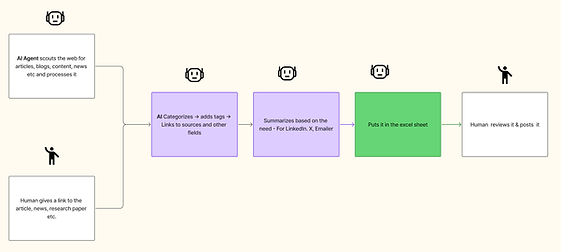


Outcome
The entire system was built and deployed which functions autonomously without the involvement of human (except in rare cases). I was able to bring down the time required to curate the content by at least ~50% and which also improved the consistency of marketing activities.

